
Career
Disha
Nepal
Job & Education Database


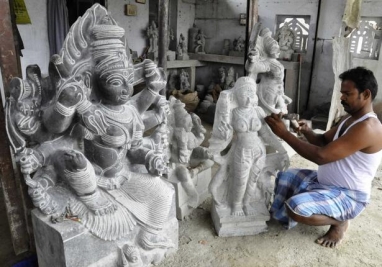
The sculptor is the person who creates anything artistic, be it statues or other aesthetic antiques. This includes carving, shaping clay, whittling or chiselling to shape those materials into a final ... learn more
Self Employment Ratio
Since there are various types of materials used for sculpting, like metal, ceramics, wood and clay. Each of the materials requires training in the given fields. There are few training courses in CTEVT ... learn more


The sculptor is the person who creates anything artistic, be it statues or other aesthetic antiques. This includes carving, shaping clay, whittling or chiselling to shape those materials into a final product. Materials used in sculpting include stone, concrete, marble, bronzed, plaster and wood.
Entry Salary / Income
Rs. (not set) - (not set)
| Security and Army | Professionals | |
| Skilled Urban | Skilled Rural | |
| Supporting Operations | ||
The table illustrates the segregation of occupations according to the level of education & experience. The segregation is such that the 'Professionals' have the highest amount of education and/or experience then are the 2 skilled labour (Urban & Rural) and Supporting Occupations with assemblers, operators etc. Security and Army have a wider range of both education and experience and are governmental jobs.
The boxes highlighted are the ones associated with Sculptor . According to ISCO, jobs can have various levels of education and/or experience which thus puts them in different boxes as visualized in the table.
| Duration | Fee (Rs) | Access without SEE | |||
|---|---|---|---|---|---|
|
Metal Sculpture
|
Skilled Urban Skilled Rural |
0 |
Yes
|
learn more | |
|
junior ceramics assi
|
303 Hours | 0 |
Yes
|
learn more | |
|
Jr.Wood Artisan
|
296 Hours | 0 |
Yes
|
learn more | |
|
This is a skill base and self employed base training which is given by CTEVT. Go to education page
|
|||||
Work activities, mental & physical: You are equally comfortable with mental or physical work, without any particular preference for either. You should consider looking for jobs where both types of working activities can be utilized. Some examples would include providing services and working in security.
Style of Working, only playful: You love it when you can be creative and you like to be able to find new ways of doing things. You should consider looking for jobs where you will have a lot of freedom to come up with your own ideas and solutions and less routine tasks. Such jobs can be found in different areas of designing and producing new content, and jobs that involve troubleshooting or finding solutions to problems
Information Processing, only detailed: You prefer to focus on a specific aspect of your work and to go deeper into the details. You should consider jobs that require you to focus and pay great attention to the details of what you are doing, and avoid jobs which require you to look at the bigger picture. Some examples would include jobs like bookkeeping, data management, software coding, fine arts, handicrafts or translation
Flexibility, very low: You prefer to have a fixed work routine with little or no change every day. You should consider looking for jobs where you are required to go to an office at a specific time each working day. Some examples would include desk jobs and running a shop.
Value orientation, only idealistic: You believe that your work must have meaning behind it, without any material importance. You should consider looking for jobs that will give you some personal satisfaction while doing it. Some examples would include teaching and doing social work.
Pursuit of Success, high: For you it is important to succeed in your work. You have no problem with dedicating your free time to your work, and you welcome challenges and obstacles. You should consider looking for jobs that will motivate you to do well and succeed. Avoid jobs that will not challenge you to perform better.
Motivation to Create, very high: You prefer to come up with your own ways of doing things. You should consider looking for jobs where you have some freedom to make your own decisions. Avoid jobs where you have to follow directions.
Competition oriented, very low: You do not enjoy competing with others, and you do not often compare yourself to others. You prefer to focus only on your own accomplishments. You should consider looking for jobs where your work is valued on its own merit . Avoid jobs where your performance is often compared to others’ performance.
Sense of Duty, very high: You often feel personally responsible for your work. You are careful when doing your work and you like to do your best. You should consider looking for jobs where you will be entrusted with valuable work that will encourage you to do your best. Avoid jobs where you are not given any responsibility for your work and that do not encourage you to do well
Analysis orientated, medium: You recognize that there is a time for making quick decisions and a time for thinking carefully before acting. You should consider looking for jobs where different kinds of decisions have to be made and where you have to discern whether the situation calls for quick thinking or a lot of analysis beforehand.
Team oriented, very low: You are independent and work best on your own. It is difficult for you to work with others and to conform your way of working to theirs but on the other hand you do not feel odd if you have to work on your own. You should consider looking for jobs which have a lot of tasksthat can be fulfilled on your own and have a low degree of collaboration with colleagues or experts you need to ask for help
Self Employment Ratio

At the moment there are people working in this job in Nepal.
Shows the demand of the career (1st being the highest and the last being over-saturated).
60 = very high: This job is very high in demand. You can easily find employment or will be able to sell your service easily as a self employed person.
50 = high: This job is high in demand. With a certain talent you will find a job.
40 = medium: The demand for this job is medium. You should have chances in finding a job, but you might need to be flexible regarding your working place or in self employment, might have to compete with a few other professionals about the work.
30 = low: The demand for this job is low. Only a few vacancies are published. Academic proficiency as well as experience is required to be even considered for applying for this sort of jobs.
20 = saturated: There is no more demand for this profession in the labour market. Only if existing staff is released, new people are hired.
10 = over-supplied: There are many graduates already waiting for a job in this profession. You might have to consider a long waiting list or have to prove extraordinary talent to find a job in this profession.
The below jobs are similar to Sculptor because of factors such as similar education, similar tasks and similar required abilities.