
Career
Disha
Nepal
Job & Education Database


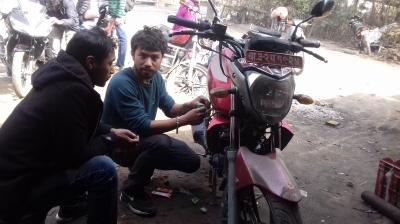
Car/ Vehicle Mechanic keeps equipment available for use, by inspecting and testing vehicles; completing preventive maintenance such as, engine tune-ups, oil changes, tire rotation and changes, wheel b ... learn more
Self Employment Ratio
A TSLC in Mechanical Engineering is available by CTEVT for individuals before SLC (after 10 pass). This course prepares competent lower level workforce in the field of mechanical engineering. This is ... learn more


Car/ Vehicle Mechanic keeps equipment available for use, by inspecting and testing vehicles; completing preventive maintenance such as, engine tune-ups, oil changes, tire rotation and changes, wheel balancing, replacing filters. The mechanic also maintains vehicle functional condition by listening to operator complaints; conducting inspections; repairing engine failures; repairing mechanical and electrical systems malfunctions; replacing parts and components; repairing body damage.
Entry Salary / Income
Rs. (not set) - (not set)
| Security and Army | Professionals | |
| Skilled Urban | Skilled Rural | |
| Supporting Operations | ||
The table illustrates the segregation of occupations according to the level of education & experience. The segregation is such that the 'Professionals' have the highest amount of education and/or experience then are the 2 skilled labour (Urban & Rural) and Supporting Occupations with assemblers, operators etc. Security and Army have a wider range of both education and experience and are governmental jobs.
The boxes highlighted are the ones associated with Car/Vehicle Mechanic . According to ISCO, jobs can have various levels of education and/or experience which thus puts them in different boxes as visualized in the table.
| Duration | Fee (Rs) | Access without SEE | |||
|---|---|---|---|---|---|
|
Heavy V. Mech
|
Skilled Urban Skilled Rural |
0 |
Yes
|
learn more | |
|
L.Veh.Service Mech
|
Skilled Urban Skilled Rural |
0 |
Yes
|
learn more | |
|
L.Veh.Mech
|
Skilled Urban Skilled Rural |
0 |
Yes
|
learn more | |
Style of Working, only applying: You prefer to have a lot of structure in your work, and you like to follow established methods of doing things. You should consider looking for jobs that are fairly routine and repetitive. Some examples would include running a business, teaching, and jobs that require physical labour.
Flexibility, high: You prefer to have a constantly changing work routine with only some things being the same every day. You should consider looking for jobs that give you considerable freedom in where and what time you work. Some examples would include online jobs, freelancing, and writing.
Sense of Duty, very high: You often feel personally responsible for your work. You are careful when doing your work and you like to do your best. You should consider looking for jobs where you will be entrusted with valuable work that will encourage you to do your best. Avoid jobs where you are not given any responsibility for your work and that do not encourage you to do well
Action orientated, very high: You prefer to take the initiative in your work and to be proactive. You would rather not wait for your work to come to you. You should consider looking for jobs where you need to drive your work forward. Avoid jobs where you have to wait for something to happen before you can do anything.
Self-confidence, very high: You have a high amount of self-confidence. It is easy for you to present yourself in front of others. You should consider looking for jobs where you will have to make presentations in front of groups of people. Avoid jobs where you will not be encouraged to talk to other people.
Self Employment Ratio
At the moment there are people working in this job in Nepal.
Shows the demand of the career (1st being the highest and the last being over-saturated).
60 = very high: This job is very high in demand. You can easily find employment or will be able to sell your service easily as a self employed person.
50 = high: This job is high in demand. With a certain talent you will find a job.
40 = medium: The demand for this job is medium. You should have chances in finding a job, but you might need to be flexible regarding your working place or in self employment, might have to compete with a few other professionals about the work.
30 = low: The demand for this job is low. Only a few vacancies are published. Academic proficiency as well as experience is required to be even considered for applying for this sort of jobs.
20 = saturated: There is no more demand for this profession in the labour market. Only if existing staff is released, new people are hired.
10 = over-supplied: There are many graduates already waiting for a job in this profession. You might have to consider a long waiting list or have to prove extraordinary talent to find a job in this profession.
The below jobs are similar to Car/Vehicle Mechanic because of factors such as similar education, similar tasks and similar required abilities.